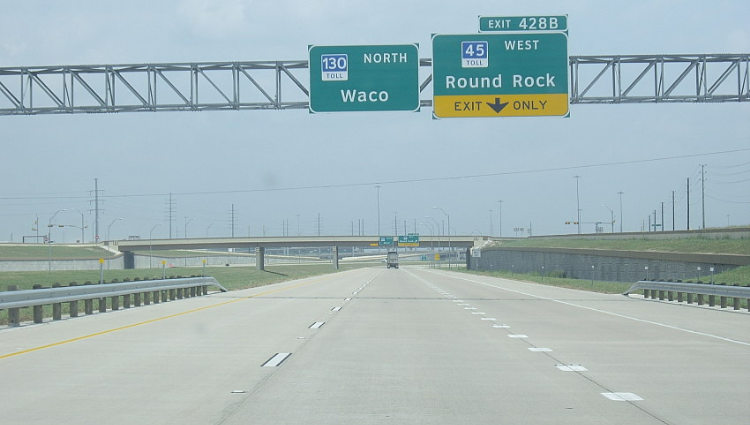
Targeted Repairs and Overlay Strategies Cut Costs and Extend Pavement Life
Premature distress on SH 130 in Central Texas raised concerns about the long-term performance of the continuously reinforced concrete pavement. Under a TxDOT Austin District contract, Transtec was brought in to evaluate conditions and recommend a practical path forward using both existing information and new data.
The team assessed more than 25 miles of pavement, covering roughly 180 lane-miles, using non-destructive evaluation (NDE) technologies like Traffic Speed Deflection Device data along with ride quality metrics, distress imagery, and GIS mapping. Instead of assuming the entire corridor needed reconstruction, the analysis focused on finding where the pavement was actually failing and why.
That work identified specific problem areas, including horizontal cracking, longitudinal cracking tied to highly plastic soils, ride quality issues, and isolated surface distress. Most of the corridor remained structurally sound. Having structural condition data available across the entire corridor provided critical insight into subsurface conditions, allowing agencies to distinguish localized issues from broader structural deficiencies and avoid costly, disruptive, and unnecessary reconstruction.
Using this information, Transtec developed geotagged repair plans that targeted the areas that needed attention. The recommendations included spall repairs, partial-depth and full-depth concrete repairs, and grinding to restore smoothness. This allowed TxDOT to fix the root causes without replacing pavement that was still performing well.
To prevent the same issues from returning, the team designed an overlay system based on FHWA’s Targeted Overlay Pavement Solutions (TOPS) approach. The system uses a crack-resistant interlayer to slow reflective cracking, along with a durable surface course built for long-term performance.
This combination of targeted repairs and overlay design improved ride quality, reduced future maintenance, and avoided large-scale reconstruction. The approach delivered an estimated $40 million in savings across 87 lane-miles and extended the service life of the corridor.
The project has received industry recognition, including awards from TxDOT and the paving community. Based on these results, TxDOT’s Austin District continues to apply the same strategy to other sections of SH 130.
Key Outcomes
- Evaluated approximately 180 lane-miles using NDE TSDD and GIS-based analysis
- Pinpointed localized failures instead of treating the entire corridor
- Designed targeted full-depth and partial-depth repairs to address root causes
- Used an overlay system aligned with FHWA’s TOPS approach to limit reflective cracking
- Saved an estimated $40 million by avoiding full reconstruction
- Improved ride quality and reduced long-term maintenance needs
- Recognized with project awards from TxDOT and industry partners
Image source: Wikipedia